26 augusti 2015

ComputerCraftEDU

I have one student who helps me with one server I rent. When school started this fall he asked if we should upgrade the server to an higher and newer version but instead I gave him a challenge:

I want a survival PvP server with ComputerCraftEDU and players on the server should not have building rights.

A challenge he took seriously and spent a bit over a weekend to get the server up and running. He had to figure out what ComputerCraftEDU was and how to configure the server settings plus server versions. I believe he read the reddit-thread to figure out how it should work.

When every new player joins the server he/she will get a start kit (a turtle, a remote control, diamond pick-axe, a workbench, 5 apples, 5 torches and an instruction manual). It's working but now he (my admin) tries to figure out how to launch the economy (shops) and ComputerCraft itself as he experienced CCedu be a bit limited.

There's a couple of things we want our vocational students to learn, alpha and omega stuff;
  • analyze problems
  • information retrieval
  • plan
  • documenting
  • test
  • evaluate
  • report

With no build rights on a minecraft server, but you have turtles, you surely have to use those skills. 


My admin student have been playing Minecraft for the last four years and he admit he start getting bored of the concept, but he found himself spend hours on this server to figure out how to program the turtles. He acknowledged the work process: to be able to survive on our server you had to use those skills.

If I can confirm the student's skills in the game, in an environment where they are safe, I might have a greater chance of getting them to do the same in the classroom and another subject...!?

Well, you don't know if you don't try, so let us try!

Now, I happened to have an ongoing course where my students will learn to document a project and it's difficult to make them understand the task. They don't see the big picture in the same obvious way that someone with professional experience does.

So obviously I put them on the server so they would understand the whole picture, why every small steps to move forward are important in the process. Moreover, by using ComputerCraftEDU (drag-drop code), we could also simulate a programming project.

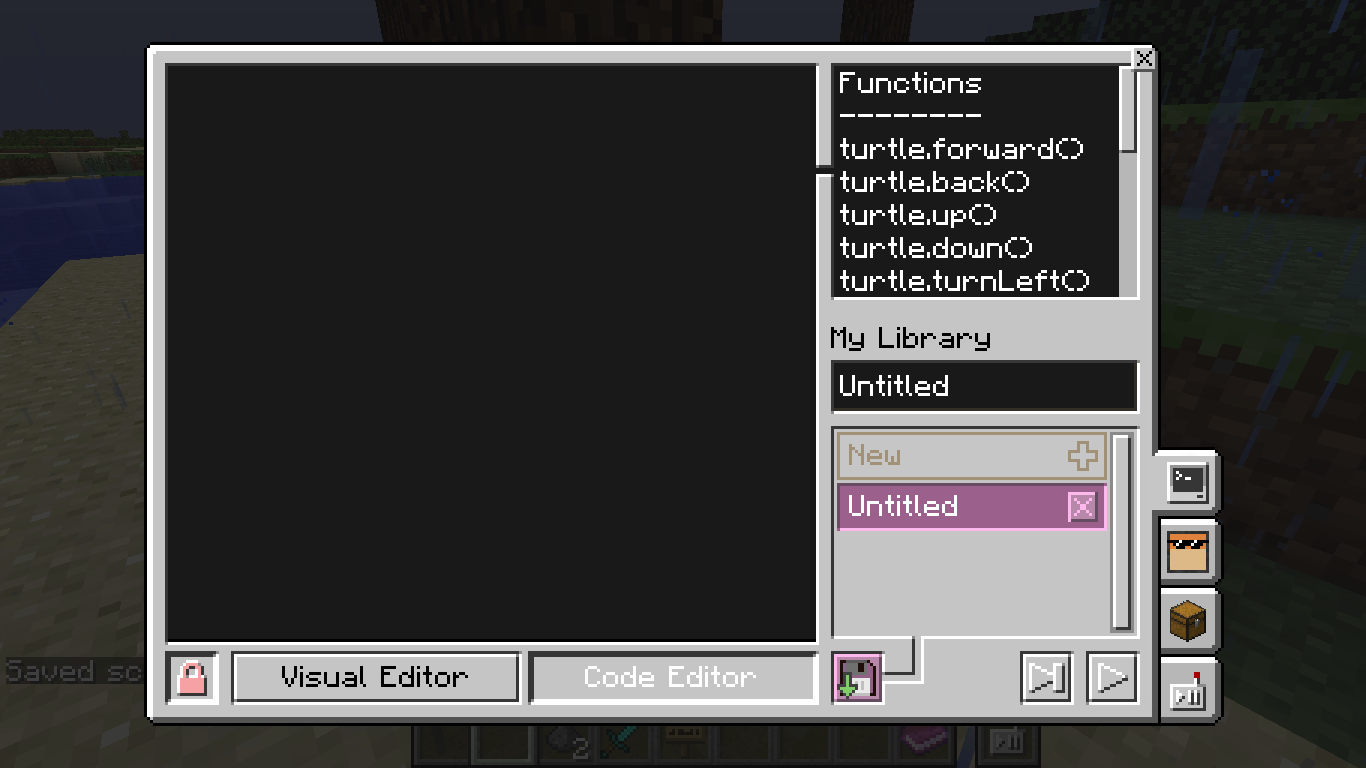

I don't know if it's a Finnish mentality that you have to vomit blood before taking a deeper reflection or whatever it is, but of course they did the opposite way of what I tried to explain. Instead of analyze, search at YouTube, plan or document they have jumped right into the game and forgot completely what I wanted them to do.

Tomorrow I have to have them to focus on the quest, the mission, instead of die in forty different ways as they try to program the turtles... And most annoying, there is some great ways to understand what ComputerCraft is, like this YouTube playlist by FunshineX

14 augusti 2015

Pseudocode and the new languages L++ and M++

This fall semester has just started. I kept my plan to use the "I Wonder..."-lesson as some kind of soft start and I've had one class two days struggle with pseudocode. It was harder than they thought. Much harder!

My plan was to have them blindly do a simple task and afterwards reveal the big secret: what they actually practiced and learned.

I understood 
during the first sub-task (the building phase) when they looked at me as question marks I have to make them understand what is going on. All has now built houses, either in Minecraft or my old architect-LEGO. 


This is something useful to know, understand and learn. Besides, if this construct code is too hard you might should have a second thought about your education. Pseudocode is still much easier to write than "real" code.

But I had to enlighten my students the purpose of the task so they could put their souls into the task. LEGO when you're adult? 17-21 years old? Are you nuts??

Their challenge?
Break something easy (but still a final product) into small steps of actions that someone who doesn't have any background knowledge both can understand as execute. Harder than it seems, that's for sure!

To make it even more difficult, another group of students (practical nurses) has also a course on disability. These practical nurses students, have  often difficults to put into that role not to understand everyday instructions. These students will debug the Business Information Technican students pseudocode (written instructions).

Coding is basically a step-by-step guide for computer to accomplish a task. Now the computer will be a human being, another student with some knowledge of Lego and most certain no knowledge of computers or videogames. Worst of all, it will most certain be a pretty girl... Our own version beauty and the geek haha!

Some of the example (pseudo)code which we've been doing together look like this:

M++ (Minecraft OOP)

L++ (Lego OOP)

What kind of learning takes place?
  • Pseudocode
  • Understanding of object-oriented programming
  • Documentation
  • ICT Helpdesk
As it gives so much learning I will continue with my other classes (all Datanom / Datanomi / Business Information Technican students) and do the same concept as I start to believe it's a useful exercise.

10 augusti 2015

I wonder...

Today I got the very exciting news with zero foresight. For some months I will be a replacement teacher for my colleague (a dad!) who will be on paternity leave. But unfortunately, foresight and planning could have been better. On Thursday, I will launch two courses on the topic "Implementation of a prototype for the software" where students will understand the point of planning and documenting projects. 

We will for example be using UML (the Unified Modeling Language), Gantt charts and Entity Relationship Models. Also flowcharts and pseudocode as it will help our students both in this course as when they start with object oriented programming.

I WONDER...
...what if I have them start in a completely different end...!?
What if I make them build something with LEGO (or Minecraft), have them to documenting their creations with camera, hand in that first task. And what if I make them to write an instruction how to build their creation? And that instruction needs to be detail in absurdity.

OKAY, MY PURPOSE?
A LEGO creation (rather than Minecraft) would be something easy to build but advanced enough to write an instruction to, targetting group someone who has never built LEGO (or played Minecraft) before. The build phase itself is something you repeat or loop, will they figure that out?

So my students, who are they? Well, vocational students between 16-19 years old, all gamers. I need to catch their interest in a very odd way I guess, this could be it. They will all be programmers so they need to start think OOP way and I believe one important skill for coding is to break a series of actions into small steps that someone who doesn't have any background knowledge (like a computer) can both understand and execute. 

Coding is basically a step-by-step guide for computer to accomplish a task and to write a LEGO instruction of their creation might be harder than you think. And we could ask other students at our school to perform the task strictly following the instructions and I'm pretty sure there will be lots of steps missed. 

AFTERWARDS
...and only afterwards I reveal what they have practiced.
  • Pseudocode
  • Object oriented programming
  • Documentation

They will also have an own example what to later do a flowchart or UML of. 
Am I nuts? 
:)

4 augusti 2015

Learning with WonderQuest

The other day AquaVera got an old decommissioned iPad from her uncle, the tool can not be upgraded from iOS 5 so it was useless for him. But since Vera belongs to the YouTube generation, it doesn't matter as long as a browser works. When I look in my YouTube history (where she use to watch from) there's a lot of crap that I even don't know how she finds (as she can't write), but still look at.

So with this "new" iPad I could make a shortcut to the YouTube in the browser (safari) so she always starts from Stampys new show "WonderQuest". Adam Clarke told me the exciting news he would be a part of it half a year ago, at a time when I was stupid enough to not understand his excitement! I had missed the Stampy phenomenon! Stupid, but at least I had repaired it now :)


Anyway, AquaVera as many of her friends, has already two languages to learn as we live in Finland: the majority language is Finnish and Swedish is the minority language. As her mum is Finnish and I'm Swedish, she already speaks two languages. But keep in mind: that's nothing unusual in Finland, even if the Finnish themselves don't always count it as a qualification.

Thanks to the TV-channel NickJr and Dora The Explorer she has already learned some English. When we moved to this new neighborhood there was a family where the father is from Scotland, the children are also two speakers: but Finnish and English instead.

Combine those facts: 
Dora the Explorer, WonderQuest and English speaken friends and you will only have one answer - she now talks three languages... She has learned a lot during this summer (not only swim, bike and so on).

This morning we talked about learning as she has been watching WonderQuest over and over. She had loads of questions, both of gaming and learning. Why a quest line? Why do you need a mission? Why challenges and puzzles?

Learning.
Different ways of learning.

And we agreed, learning is - or can be - fun. 
And when it's fun it's most often multplayer.

Two weeks ago AquaVera played Disney Universe, a co-op pvp action video game, with her second cousin W. 


They practiced collaboration and later took this new skill try to steer and navigate our boat (they took turns), not bad for two 7 year old children.


Again, all you (as a parent or teacher) have to do is show interest (you don't have to master the subject) and tie all together, enlighten the learning, get them to reflect (talk, discuss, write, chatt).

Learning is not any longer one subject at a time (the analog way, teachers and school), it's multi-learning (the digital way, our children and pupils).

WonderQuest is a shining example of multi-Learning, even without having English as native language! Why? The enviroment is safe, they have been (and can go) there themselves and afterwards you can download the map and experience the last episode (press buttons, solve puzzles) and learn more. 

The show also follow the USA common core of grade 2 in the curriculum and according to Wizard Keen they aim to create an engaging story driven content multi-Learning enviroment (science, math, literature etc)

And the makers reach a bonus learning that are so obvious that they don't think about it: language
English for non-English speakers. 

And just as important: courage
"Dad, call Wizard Keen and see if he wants to play Minecraft with me, English won't be a problem!" 
(AquaVera 7yo)

Suggestion to the makers: 
Make exercise books inside Minecraft that you could get access to after downloading the map, could be keywords (vocabulary) from the current episode.

This way of teaching is definitely on the fourth stage of the SAMR model. Tech has made the impossible possible, you can walk inside the exercise book and experience the learning in a 3D way.

Best of all: 
As a remedial teacher (vocational institution) I can use the small "I WONDER" episodes myself when I try to explain the basic stuff for my weaker students. Most often they rather learn from YouTube instead of a book. One of the frequent missing knowledge is measurements, metre, decimetre and centimetre. I believe I will have good use of this episode the upcoming fall


9 juli 2015

To learn coding without a computer

Just because we've been out of computers, Internet and Minecraft it doesn't mean we - AquaVera and I - have stopped thinking or been trying to learn new stuff. In fact, we've doing some exercises to learn computer coding as many thinking and coding approaches can be learned in off-screen activities.

iGameMom (games for learning) wrote a blog post about it some weeks ago (right in time!) and we started to break series of actions into small steps that someone who doesn’t have any background knowledge (like a computer) can understand and execute.

So, when building a Minecraft house, what do we do?
Well, according to AquaVera, soon 7 years old, it was easy: we build walls, roof, windows and doors. 

This was our series of action that we needed to put into smaller steps as she, with a second thought, understood neither her uncle or grandfather would understand the concept without smaller pieces of instructions.

As we discussed the building phase in Minecraft (press E for inventory), choose block, place block (right click) she got tired of my stupid questions and streamlined the work: some tasks, which you do often, you can gather under one command.

She understood we have to get really small steps to make it working, but of course she also got tired quickly so we couldn't talk for hours, but some small talks here and there. Repetition and variation, when she started to think differently I also explained the larger context. It is possible to combine business with pleasure, that it doesn't need to be boring to learn something new, difficult and perhaps abstract.

Then, on a rainy day we started to play with LEGO. We had the instructions ready, now we had to test them - and first up: how big (tall) is the LEGO figure? It's easy in Minecraft as Steve is 2 blocks and the bed (as the door) is also two blocks. But what would it be in LEGO? Well, she understood it couldn't be 2 block but she estimated it to four blocks.


Five blocks!? now we had a problem as you can't cut a LEGO block into 1/2 (but in 1/3). OK, so now we also had to consider scale and sizes (math), and some nice discussions as we was playing as well. 

Learning is fun and learning is multiplayer!

First thing you have to do: find a nice spot! 
And, as we now knew the guys are 5 blocks high we had to start think how long would the bed be? First she said we could use either 4x6 or 4x8 plates but when I gave her 3 red+1 white block (2x4) she decided all beds has to be 4x8 and when the red blocks ends we just use another color.


She gave me small instructions how to build the house and we had to build the bottom layer first so we could see how big the house would be. This was new: she usually builds wall by wall in Minecraft and no houses at all with LEGO.


Of course or builders got hungry so we also had to put up a farm just outside...


No roof is needed as we have to be able to move our figures in and out. As you can see of the last picture she also realized when we built the ground we had to make the house bigger so we could fit working bench and stove.

Another thing about the code learning. As she's learning to ride a bike we play Instructed Map Route where I'm the smartphone and she's the gameapp: She gets short instructions where to go. 
Follow this road, take left, in the next crossing take right. 
When she gets excited over handle shorter instructions and want to have longer ones she starts to mess up where to go and drives wrong. Luckily it's a small town and no cars on the roads :D


The latest thing we have started to do is to use a "secret language" which with the hama beads. In fact, the secret code is binary counting and the ASCII code table. Each letter has it's own 8-bits pattern with two colors (0 and 1). And as she got her uncles old iPad yesterday she needs to do something special in return I believe a hama beads cration with a binary message would fit like a glove!


Summer school

I've been out of both Internet and also workspace for the last month as we've been moving, but now we're back on the online track. Unfortunately I couldn't tell you the amazing news when it happened, but...
  • The Finnish board of education has approved an application where the Finnishswedish vocational institutions will test Minecraft as an educational tool during 2015-2016. My role? advisor...
  • I forgot to cancel a Minecraft server contract so we - our school - have to pay it over the summer. But I got a brilliant idea, as we anyway pay for the server we can let our students use it! ...because some of them will anyway play Minecraft... and when they do use it they maybe want to do some quests as well to exchange for studypoints and voilá! we have a summer school!!!
I convinced my principals that it's worth a try and I have some quests up and running, when the next semester starts we'll see how much work (and time) they have put into the game. And the easiest quest is very simple: be creative! You can't fail...

1 juni 2015

The plane crash!

The Finnish vocational education consists of 75% vocational subjects, 17% joint (eligibility for further study) and 8% subject courses to choose and who should strengthen your career choice. Within the last 8% I usually find opportunities to give courses with other and new methods such as math in Minecraft or business in World of Warcraft.

During this school year, I have had rolling minecraft courses in order to practice on key competences for lifelong learning and as my principal didn't know what to call them (the courses) we named them "Math in Minecraft". But, like my colleagues, students have difficulty connecting games with learning and they have become very confused when I asked them to play together toward a larger goal, like building a nuclear plant (Industrial Craft) and you'll learn math, language, problem solving while playing.

To force them to collaborate was a too hard task as they came from different classes, as well as to see a bigger goal. Even though they are between 16-18 they have big difficulties to see the whole picture, to understand the chain of what it takes. You have the soldier for example, one soldier in the army requires 10 workers that will make sure he has food, armor, weapons, protection and so on.

Lesson 1:
Don't think that they are already adults, give them small targets to work towards.

One day when I'm was in the final stage of the fourth round I had to give them a homework assignment. I used Google Form, gave them a mission "compare the time it will take you to dig to the bedrock with and without equipment (food or weapons). Count how many times you die as well as all the material you mine". And suddenly they started working and also requested more assignments.

Lesson 2:
As they can't see how you learn with games you have to choose the boring way to make them work, make them understand, give them a form to fill in!

So to my final course I created a scenario (with some help from my friend Spelläraren), a plane crash! You have to survive! All you got with you from the aircraft was a broken radio: you can receive messages but not send. 


The plane crash! (course site and hopefully Google translate works)
I managed to find an old news story about a plane crash in Finland that I started from, and from that start I would - on a weekly basis - try to push the plot forward. The angle of this course was to get students to understand the coordinate system where many have difficulty understanding 2D (X and Y axis) but easier to understand 3D chart Minecraft (X, Y, and Z axis).

The students have thought I've been crazy, how can I learn math from Minecraft? But this note might bring some brightness?


During the course, I lost the motivation multiple times because my students did not give me any feedback and I was not sure if I did the course in this way for me or for them. 

Unfortunately, there was a course with few close study hours, and therefore it was not more than six missions, five of them with the help of Google Form and the sixth to reach the goal and inside the game write a report (with book and quill) and answer the questions:
  1. Did you like this way of running a course, through action and with mission come forward?
  2. What has been the biggest challenge?
  3. What have you learned?
  4. When did you learn it?
  5. Why did you learn it?
So first when the course is over, I've had them to start reflect what they have been doing. Voilá! You've been doing math all time!


And now I got the feedback, they had all liked the way of how I challenged them - but sometimes they thought I had a bit too long distance (too many blocks) between the missions. My thought had been that they would be much more active, move more, sneaking up on each other and also to move forward in the direction I decided. 

Lesson 3:
It not only helps with a story line but the students also appreciate it!


Just because PvP was allowed doesn't mean that it's the smartest solution to solve all conflicts. With MinecraftEDU it would have been easy to separate the warring parties, have a discussion, and get them focus on target (to be saved). Instead, they spent four lessons with trying to kill each other and after that day, they realized that they had not come any closer to the goal and that day was a waste of time.

Lesson 4:
Try to keep them busy! Then they don't have time to do something else.

One of the problems they had to solve was something you could either test inside game or draw a scheme of: 

If you manage to catch two animals you can get them to mate by feeding them. Cows for example, you feed hay (wheat) and two animals can have a child every five minutes and it takes 20 minutes for a baby to grow up. You have two cooldowns to keep track of.

Multiply 2 animals maximum of 30 minutes, how many animals do you have when the time runs out?

Conclusion
This course form worked and I will continue to use that. You shouldn't get too many math task, the fact is less than half will be schoolstuff and the rest must be games: "keep the illusion alive" (as spellararen told me).